AI doesn’t have to be revolutionary to be valuable.
At Revolt, we’re not trying to replace teams or automate everything. We’re focused on something much simpler: using AI to remove friction, reduce manual work, and help our team make better decisions faster.
Here’s how we’re actually using AI today in our internal processes — nothing futuristic, nothing impossible to replicate.
1. Internal Alignment and Operational Clarity
When you work as a remote-first team with international clients, alignment matters more than ever.
One recent example was building our 2026 Argentina holiday calendar. Instead of manually checking dates or relying on outdated shared documents, we:
-
Integrated the ArgentinaDatos API
-
Connected it to our internal workflows
-
Automated updates so everyone works with the same source of truth

The result:
-
Fewer misunderstandings with international clients
-
Clear planning from day one
-
No “check Google again” moments
It’s simple. But operational clarity compounds over time.
2. Meeting Summaries and Decision Tracking
We use AI to support (not replace) our conversations.
For internal meetings and client workshops, we:
-
Generate structured summaries
-
Extract action items
-
Track decisions automatically

This helps us:
-
Reduce follow-up friction
-
Avoid missed tasks
-
Keep decisions documented and searchable
It’s not about delegating thinking to AI. It’s about freeing cognitive bandwidth so we can focus on strategy and problem-solving.
3. Faster Research and Competitive Analysis
When exploring new industries or preparing proposals, AI helps us accelerate early-stage research.
We use it to:
-
Summarize industry reports
-
Identify competitive patterns
-
Structure hypothesis drafts
-
Organize discovery insights
The key difference is this:
We don’t treat AI outputs as final answers. We treat them as starting points.
This shortens research cycles without lowering standards.
4. Proposal Drafting and Structured Thinking
AI is particularly useful when structuring ideas.
Internally, we use it to:
-
Draft proposal outlines
-
Stress-test value propositions
-
Reframe positioning angles
-
Generate alternative messaging approaches
It’s like having a fast brainstorming partner — but the final judgment always remains human.
What changes is speed.
What doesn’t change is accountability.
5. Workflow Optimization
We’re also experimenting with small automations inside our operational stack:
-
Trigger-based documentation updates
-
AI-assisted internal reporting summaries
-
Automated content repurposing across channels
-
Smart formatting for structured deliverables
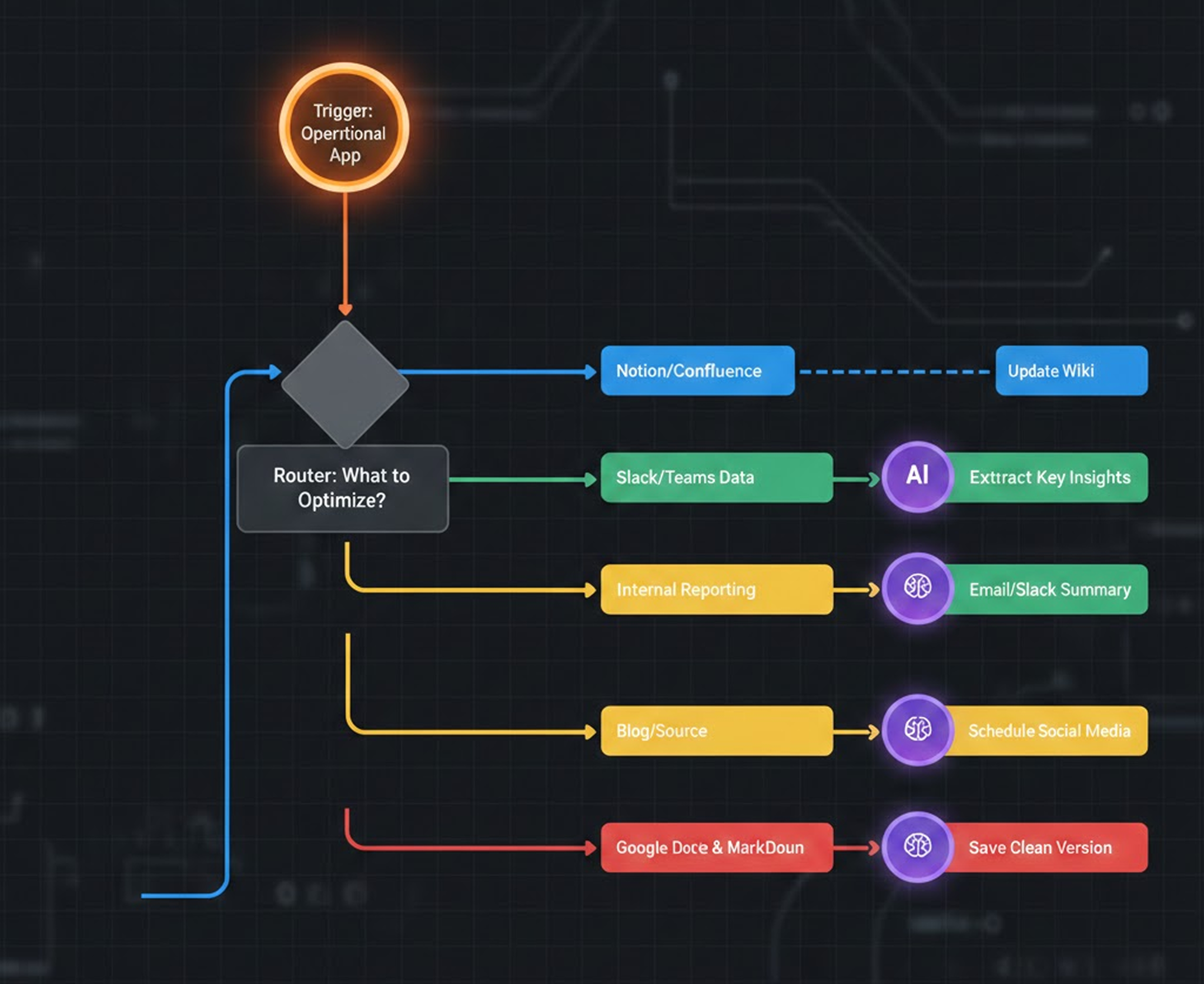
These are not “big AI transformations.”
They’re small optimizations that reduce repetitive tasks.
And those small optimizations add up.
6. What We’re Not Doing
We’re not:
-
Replacing strategic thinking
-
Shipping unreviewed AI-generated outputs
-
Building systems without evaluation criteria
-
Implementing AI just to say we did
We’ve seen enough hype cycles to know that technology without judgment creates more noise than value.
The Real Benefit
The biggest impact of AI internally hasn’t been dramatic.
It’s been:
-
Fewer small frictions
-
Faster iteration cycles
-
Clearer documentation
-
More structured thinking
-
Better internal alignment
AI, when used well, becomes invisible.
It quietly improves the way work flows.
A Practical Philosophy
For us, AI is not a headline.
It’s an operational layer.
We focus on:
-
Clear use cases
-
Defined outcomes
-
Measurable improvements
-
Human oversight
If a workflow becomes simpler, clearer, or faster — and quality stays high — then it’s working.
That’s how we think about AI today at Revolt.
And it’s just the beginning.